
Interventional psychiatry
Transcranial Magnetic Stimulation (TMS) Therapy
TMS — a non-drug, non-invasive treatment for depression and OCD, and an adjunct option for PTSD, available at our West Palm Beach and Okeechobee clinics.
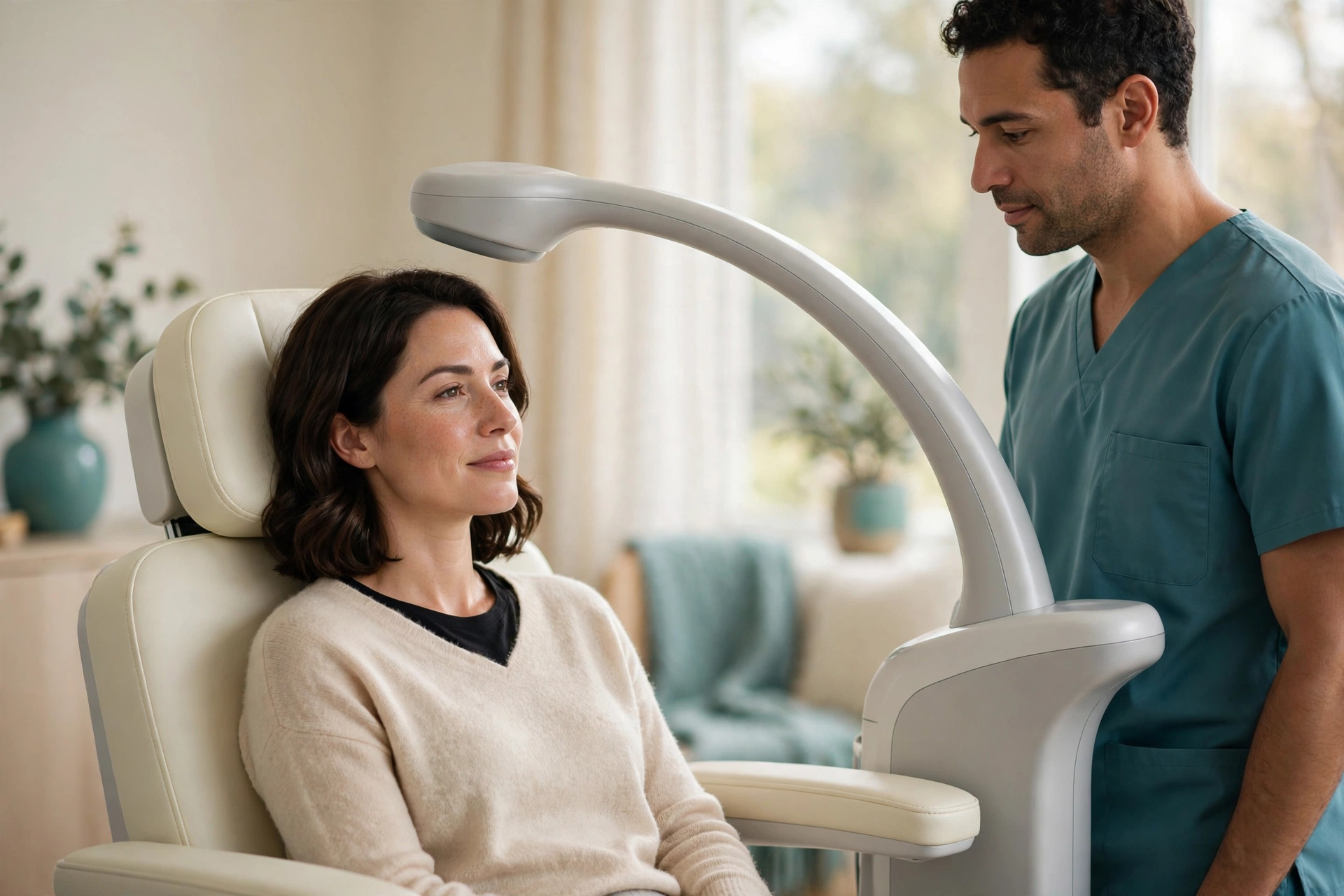
About this service
Transcranial Magnetic Stimulation (TMS) is a treatment option for people whose depression, OCD, or PTSD hasn't responded to medication. It's non-drug and non-invasive — using gentle magnetic pulses, similar to those in an MRI, to stimulate underactive brain areas involved in mood regulation. The MagVenture TMS systems we use are FDA-cleared for depression and, as an adjunct, for OCD; how TMS is used for PTSD is explained below.
What is a TMS session like?
No sedation, no "shock," no surgery. You sit comfortably in a chair, fully awake, for sessions of about 20 to 40 minutes. You can drive yourself home and resume your day immediately — no downtime, no lingering drowsiness.
How long is treatment?
A typical course spans several weeks of weekday sessions. Many patients describe a gradual lifting — motivation returns, the heaviness eases. TMS begins with a thorough psychiatric evaluation, and your provider monitors your response throughout.
What technology do you use?
Health Haven delivers TMS using MagVenture TMS technology, under board-certified psychiatric oversight with medical director review of all treatment decisions.
Where is TMS offered?
TMS is currently available at our West Palm Beach and Okeechobee clinics only. Many commercial insurance plans and Medicare may cover TMS for major depressive disorder when specific criteria are met — our team will verify your benefits before treatment begins.
A consultation is required to determine whether TMS is appropriate for you. Call (863) 261-8354.
PTSD
TMS for PTSD
Post-traumatic stress disorder (PTSD) can develop after experiencing or witnessing a traumatic event. It can affect mood, sleep, concentration and emotional well-being — through intrusive thoughts or flashbacks, feeling constantly on edge, sleep problems, or emotional numbness and avoidance. For many people, medication and psychotherapy alone don’t bring enough relief.
How TMS is used for PTSD
For PTSD, MagVenture’s technology is used as part of the MeRT® System by Wave Neuroscience, which is FDA-cleared for adjunct treatment of adults with PTSD. MeRT (Magnetic e-Resonance Therapy) personalizes TMS: it combines the magnetic stimulation with brainwave analysis (qEEG) and heart-rhythm data (ECG), which are used to tailor the stimulation frequency and targeting to each person’s brain activity. MagVenture does not hold a separate FDA-cleared indication for PTSD; the PTSD clearance belongs to the MeRT System.
Who it may suit
TMS for PTSD is an adjunct treatment for adults — it is added to your ongoing care, not a replacement for it. It may be worth discussing if therapy and medication haven’t been enough on their own. Whether it’s appropriate for you is decided with your psychiatrist after a full evaluation, and no treatment can promise a particular result.
What treatment looks like
TMS is non-invasive and needs no anesthesia or surgery. You stay awake, and you can return to your usual activities right after each session. Side effects are usually mild and temporary — most often scalp discomfort or headache; tingling, muscle twitching or lightheadedness can also occur. Your care team will explain your treatment schedule before you begin.
Alongside therapy and medication
TMS for PTSD works within your wider care plan — for example trauma and PTSD care and medication management — and your psychiatrist monitors your progress throughout.
TMS is offered at our West Palm Beach and Okeechobee clinics only. Read more about PTSD and trauma, or call (863) 261-8354 to ask about a consultation.
MeRT® is a registered trademark of Wave Neuroscience, Inc.
FAQ
TMS questions
What is TMS?
Transcranial magnetic stimulation (TMS) is a non-invasive, outpatient treatment that uses magnetic pulses to stimulate nerve cells in areas of the brain that influence thoughts, emotions and behavior. During treatment, a small coil is placed on your head.
What conditions is TMS used for at Health Haven?
Depression, OCD and PTSD. The MagVenture TMS systems we use are FDA-cleared for adults with major depressive disorder who haven’t improved enough with antidepressant medication in the current episode, and as an adjunct treatment for adults with OCD. For PTSD, see the next question.
Is TMS FDA-cleared for PTSD?
The FDA clearance for PTSD is held by the MeRT System by Wave Neuroscience, for adjunct treatment of adults with PTSD. MagVenture’s technology is part of that system, but MagVenture does not hold a separate FDA-cleared indication for PTSD. Your psychiatrist can explain how TMS would fit into your PTSD care.
Who might be a candidate for TMS?
TMS may be worth discussing if medication or therapy hasn’t given you enough relief. For depression, the FDA clearance covers adults who haven’t improved enough with antidepressant medication in the current episode; for OCD and PTSD, TMS is an adjunct treatment for adults, used alongside other care. A consultation and psychiatric evaluation are needed to decide whether TMS is appropriate for you.
What is a TMS session like?
You stay awake, and no anesthesia or surgery is involved. Magnetic pulses are delivered through a small coil placed on your head. Some people notice scalp discomfort or tingling during treatment.
How many sessions will I need?
For depression, TMS typically involves daily sessions over several weeks. For OCD and PTSD, your psychiatrist will explain the treatment schedule that applies to you before you start.
What are the side effects of TMS?
Side effects are usually mild and temporary — most often scalp discomfort or headache, and sometimes tingling, muscle twitching or lightheadedness. They tend to resolve quickly. Seizures are rare when treatment follows TMS safety recommendations.
Can I go back to my normal day after a session?
Yes. TMS doesn’t require anesthesia, and you can resume your normal activities immediately after each session.
Who should not have TMS?
People with non-removable magnetic-sensitive metal or metallic devices implanted in the head, or in body parts near the treatment coil, should not receive treatment with the MagVenture TMS Therapy system. Your care team reviews your medical history before treatment.
Can I keep my current therapy and medication?
TMS can be part of a broader treatment plan. For OCD and PTSD it is used as an adjunct — added to ongoing care rather than replacing it. Any changes to your medication are decided with your psychiatrist.
Where is TMS offered?
At our West Palm Beach and Okeechobee clinics only.
Is TMS covered by insurance?
Many commercial insurance plans and Medicare may cover TMS for major depressive disorder when specific criteria are met. Our team will verify your benefits before treatment begins.
How do I find out if TMS is right for me?
A consultation is required to determine whether TMS is appropriate for you. Call (863) 261-8354.
Providers
Providers who offer this

Next step
Appointments are booked with individual providers.
Prefer to talk to someone? Call (863) 261-8354.
Book an appointment